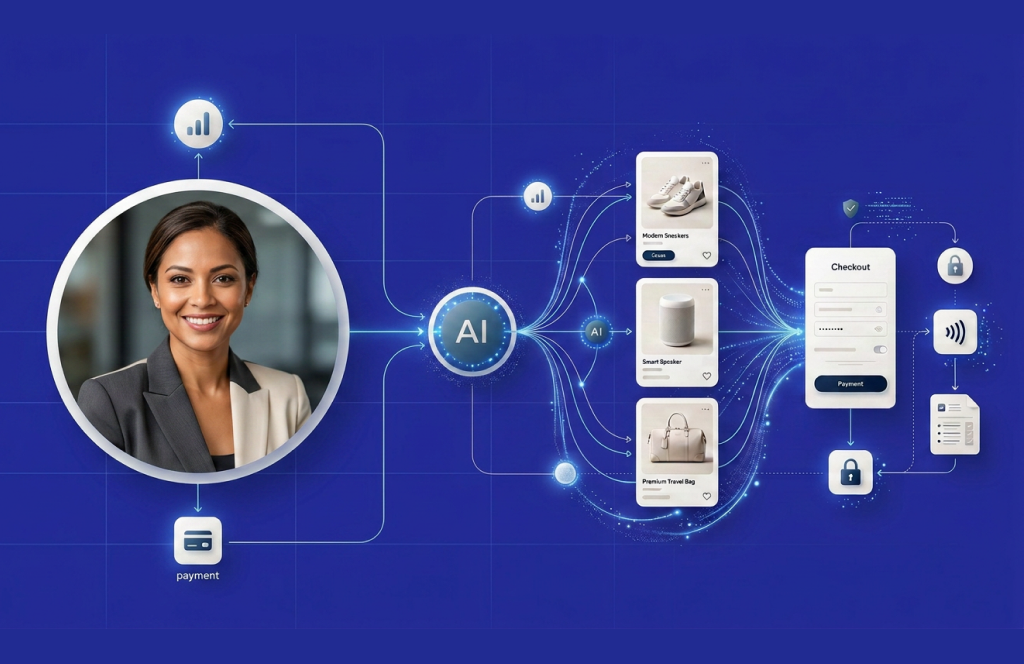
Agentic Commerce: How AI agents are transforming payments, consent, and trust
Podcast transcript
Søren Winge: Welcome to our podcast, Nexi Talks. My name is Søren Winge, and I'll be your host. Today we're talking Agentic Commerce. Is it the future of retail? What does it mean for the future of online checkouts, and what are the risks and opportunities of this emerging technology?
Today, I'm joined by Cristina Conti, Head of Customer Engineering from Google Cloud, working on applied AI projects and looking at transitioning clicks to conversations, the shift from SEO to AEO, and of course, Google's AP2 and UCP protocols. Welcome to you Cristina.
Cristina Conti: Thank you. Hi, Søren. Very excited to be here and discuss about the future of Agentic Commerce.
Søren Winge: Likewise. And also we are joined by Michael Pfeiffer, who's bringing years of product engineering and business expertise to his role as Vice President of AI and Agent Commerce as part of the Agent Commerce Alliance. So also welcome to you, Michael.
Michael Pfeiffer: Thank you very much. Excited to be here and looking forward to the conversation.
Søren Winge: And also Raja Saggi, a sought-after advisor and go to market strategist who spent I think almost a decade with Google and is now, I'm pleased to say, , with us at Nexi as Executive Vice President of e-Commerce in Group marketing; welcome to you also, Raja.
Raja Saggi: Thank you Søren. I'm super excited to be here with such a great panel. Really looking forward to the conversation.
Søren Winge: So, , let's, let's, , dive into it. , maybe let's start with you, Raja. I mean, everyone's talking about agentic AI and agentic commerce, but what does it actually mean and why is it different from what we've ever seen before?
Raja Saggi: So I think the word agentic started appearing on the scene sometime in 2025. And the way that I think about agentic is that, these are AI tools that have a level of autonomy, right? So you do not have to engage with them every step of the way. They take actions based on the context, , and the instructions that humans have given them.
And so it's literally like your assistant. Now, if you apply that to the phrase agentic commerce, I like to think of it as my personal shopper, right? I, I'm not really big into shopping, I'm a bit of a geek, but I know that there, I know there are people who have shoppers, personal shoppers, and I, you know, I envy them, right?
Because all of the picking and packing you know, the, the things that I don't like about shopping can effectively be automated for me as a geek. So agentic commerce takes away things like browsing through multiple different variations. It enters your information into the payments, the checkout process, and then it carries out this instruction on your behalf.
And me as a consumer, all I need to do is approve the options and everything is seamless. What's interesting about this field is the speed at which it's developing, right? So, agentic came onto the onto the scene in 2025, and throughout 2025 and now into 2026. There have been launches pretty much every month and sometimes several times a month.
So the ones that are especially noteworthy were, in September, 2025, which feels like a lifetime ago, we had, , Google launch its AP2 protocol. At the same time we had OpenAI under the ChatGPT brand launch instant checkout. So for the first time, you had a protocol that helped merchants enable agent commerce in a secure way, and you had an actual implementation of you know, agentic commerce solution very tightly controlled within the ChatGPT tool. We've seen, you know, multiple other players as well, such as Amazon, and implementations through companies like Walmart and Target. One more noteworthy launch was what Google did in January this year, the UCP launch, and I think we'll talk a little bit more about that later.
Broadly speaking, we're entering a world where everyone has a capacity to have their personal shopper. It takes away a lot of the tedious work of shopping, and it enables us you know, to get what we want. With a little bit of AI goodness baked into it.
Søren Winge: What's your perspective, Cristina, on this? I mean, how is it, how is agentic commerce evolving today?
Cristina Conti: First of all, I'm going to say I love shopping. So Raja, I'm going to be the very first consumer of all of this stuff, because I do love shopping. I can tell you that. So, I think when I look into how what Google perspective is here and how we see the evolution of agentic commerce.
Raja said a very important point: AI goodness baked into it. So if we want to break down how we seeing the transformation of agentic commerce from a technology standpoint, we are really seeing this build of proactivity and autonomous AI agents that basically will support the process of purchase through an entire customer experience.
Probably in three main pillars where the first one is anticipating. The AI agent can know my consumer needs, even before anticipating what the consumer is actually looking for. I would say that reasoning is really the next piece. How do I ask those questions in the shift from keywords to conversational search and how do I find exactly the perfect product, the perfect service, the perfect price that matches me as a person with the context of my own needs and reasons, knowing where I come from.
And I think the last piece is the shift towards acting because the agents here is anticipation, reasoning and acting because the agent is getting able to complete the entire journey, meaning the entire transaction for the customer. And from, again, from a technological standpoint, this reflects into a few main pillars from our side where obviously the first one is and remains data.
Merchants, consumers, products need to have their relevant data that the agents can select and pick from to make sure that the data, that the information that the end user receives is the correct one. Obviously, the long history of Google in search makes this the perfect, I'm going to say the baked goods, in this case is the available data that relates to the merchant's own data, the merchant's own catalogue to surface into the agent so that the agent knows what it has to select from.
The next piece is the platform that can allow the retailers, the merchants, and companies in general to build these branded AI agents that can be deployed and made available quickly to guide through the customer relationship at every step of the way. All of this from a technological standpoint needs to be supported by open protocols that create that same universal language for AI agents, commerce systems, and data to talk to each other.
So I think going back to what we've seen growing over this past couple of years, we started by enforcing agents that can talk to each other. So protocols like ADK, A2A are becoming crucial to make sure that in the interaction, in the conversation, interaction in the data interaction, these agents can take the best benefit of each other by maintaining security.
If we move next to that, protocols related to commerce and payments are critical because having protocols that create universal languages for commerce system and agents to ensure seamless transactions is where UCP is all about. And AP2 obviously provides that building block for trust, trusting the payment process with verifiable credential cryptography mandates and audit trails that can make sure that they reflect the real purchase intent of the customer. I'm going to mention the last list of protocols that we obviously are looking at. I didn't mention MCP before, but that is obviously another critical protocol in making sure that agents leverage on each other and on the relevant data.
But also we see emerging protocols around how the web experience of the end users is going to look like. So how end users are going to be able to leverage on protocols like, AI to UI. Which basically means that the agent will also be able to anticipate visually how the end customer, the end consumer is going to receive that message.
And this is very powerful because ultimately it creates a frictionless and personalized commerce experience for obviously me who loves to shop.
Søren Winge: That sounds great with this individualized service. Michael, let, let me bring you in here. I mean, you've been instrumental in co-founding the Agentic Commerce Alliance, which aims to help businesses of all sizes benefit from agentic commerce.
What, what is the wider merchant perspective and view of agentic commerce, as you see it?
Michael Pfeiffer: So one of the reasons that we started the Agentic Commerce Alliance, which was initiated by us here at Shopper, and then we, of course are collaborating with partners like Nexi to enable commerce, brand leaders to be early adopters of agentic commerce.
And what we're seeing is that there are a lot of big questions open currently for merchants that are around retailer fees, relevance, consents, governance, risk and trust, and what we see at Shopware, and then also across all the partners at the Agentic Commerce Alliance is that merchant interest in agentic commerce has risen considerably since Google and UCP at the NRF in January.
And while we as vendors really like to talk about protocol specifications, what we're also seeing in the market is that merchants themselves are not so much asking about the details of those protocols, but they're asking, how do I implement this safely? How do I manage risk and compliance, and how do I create measurable business impact?
And this is also why with the Agentic Commerce Alliance, that's really where we focus enabling merchants with practical adoptions in real business environments. And this is what we see right now is really needed in the market. In addition, of course, to open protocols, because ultimately what we believe is, if we think about where we are today, we're seeing a small set subset of what agentic commerce will be in the future. So today we're still fairly far from the ultimate promise of fully autonomous commerce from intent through discovery, checkout fulfillment and aftercare, both in owned and non-owned environments.
And for that reason, in order to be able to really realize that ultimate promise, we believe that the long-term success in agentic commerce will depend on open standards and interoperability. And that's also why we're so excited to work with Nexi and partners like PayPal in the Agentic Commerce Alliance.
Raja Saggi: Can I just pick up a few points here? I think both Michael and Cristina made some really interesting points there earlier. So number one, from Cristina's perspective, Google's view of the world is one of an open ecosystem, but that's not the only view that exists out there.
When OpenAI launched its instant checkout product, it was more like an iPhone versus an Android moment, right? So with iPhone, you have everything tightly curated, controlled. It works within that environment. With the Android version, the Google version, everything is much more open and can work anywhere.
It can work within the Gemini chatbot or the ChatGPT chatbot, but it can also work on the merchant website. And I think this is the challenge with this space because, and I think that's the point Michael made really well, if you're a merchant and you have to make sense of this ecosystem this completely dramatic change from clicks to conversations that's affecting every single stage of your customer journey: where do you decide where to place the bets and in what sequence? I think this is the number one question that merchants are asking themselves.
And you know, I think our job at Nexi is to try and make, help merchants make sense of that. Not just in the payment space, which is obviously where, which is core to us, but also in adjoining our adjacent spaces where our infrastructure can impact their choices and their decisions. You know, open versus closed and how you make investments is a complex process that we all need to come together to support the merchant ecosystem with.
Cristina Conti: You make such an important point, by the way, because you said something around where to invest and what to decide and how to do it. The most important thing, it sounds like a paradox, but one of the most important things when decide where and how to bring an agent to a website, to an application, to a use case, is really thinking about which user journeys we need to address and how and why.
And that is one of the main decisions that merchants ultimately need to make when they think about what do my customer needs, how can I help them? User journeys are so critical.
Søren Winge: So these, these protocols you talked about, Cristina, in many ways also building blocks that have been made but need to be put, put together very much by the merchant themselves to address the specific needs of their customers, right?
Cristina Conti: Yeah. Yeah. So I think we mentioned a few times earlier the need of trust and building blocks building blocks are really crucial to a number of steps in the process. Because if we really think about what, if we really think even about the, and I'm, I'm going to take us back a bit maybe to the early days of internet, even like creating the common language and building blocks for networks to actually have that dialogue is critical. So if we think about what are really the building blocks and where the standard protocols are, the way to build this building blocks, what we eventually need, and it does go back a bit to the openness, but it is that interoperability.
In order to make sure that the agents work where they need to work in the way that we want them to work, implementing things like guardrails for trust, and at the same time working them through one single agent integration rather than having individual pieces that do not talk to each other, because let's face it, if I have a great search engine on a merchant website that cannot actually complete the user journey, that building block by itself is not going to be relevant. It's going to be useless because it's only going to respond to part of the journey. So as we think about using these protocols in the context of agents with the right data, which to me are the three critical building blocks of having a truly agile commerce experience. And as Raja was saying, we are going at such a speed that we, and Michael actually said it too, we are really in an early stage of what this is going to mean.
But we have to keep in mind these three steps. Keeping in mind that interoperability lowering barriers of communication, innovate in the services that we provide, maintaining that trust and maintaining that trust is really the key step where having a standard protocol is critical because that is where we can guarantee security, consent, verification, trust on the agent and on the merchants.
On the consumer, the transaction and the user journey that's being addressed is the right one. So having in mind all of the steps while knowing how agentic AI works in terms of agentic design and agentic building is critical to ensure that even at this early stages of development and use cases, we have things that not only work, but that are actually helping us in a trustable manner.
Raja Saggi: Can I pick up on this point that you made about customer journeys? I think it's super interesting and the way that I look at it, I’d love your validation or challenge here, Cristina and Michael. So, in my view of the value chain that merchants have to deal with, the beginning and the end bits are relatively well understood. What do I mean by that? Everything from searching, you know, browsing for a product. looking at the different options, you know, that's largely solved. You could argue that there's little, there's bits of it, for example, making your product feed available to ChatGPT and Gemini and so on, so forth, but we kind of know the outlines of how browsing behavior will happen. So if I was solving for, a customer journey, which is how do consumers look for my products and services? We more or less know how that will happen. The end bits of that, which are if they bought a product or service, how do they get customer service through conversational interfaces?
Once again, we more or less know the outlines of how that will happen. It's the middle bit after they've browsed for something, identified it, and then they want to check it out. That's where a lot of the things that you just described, trust, verification, liability – that is the most complex bit that, you know, we as organizations and ecosystems are trying to solve and which is confusing to merchants as well.
So if you agree with that view of the world then, and coming back to Michael's point, how do merchants invest? My recommendation is that merchants should already invest in being discoverable. They should already invest in servicing their customers. They should not wait for those two things. Those are must do.
I think they should then build the, build, put in place, the building blocks of the foundations, Cristina, as you said, for that middle bit, which is all about, verification, trust and liability. Do you agree with that?
Cristina Conti: I agree 100%, but I want to hear what Michael thinks here, given his strong knowledge and awareness on the UCP protocols as well.
Michael Pfeiffer: Yeah, I think you're bringing really up really interesting points, right? Especially what I appreciate about what both of you said is looking at trust both from the lens of the consumer, which is going to be super important, but then in addition also from the sense of the merchant and in terms of what can merchants do today, it's really thinking about what decisions am I comfortable delegating and are what rules and with which safeguards. And one thing that we have to keep in mind as vendors is that, of course, for years we've operated in a way where we are trying to remove bots from the equation. Right now, we're reintroducing agents – way more capable agents – into the end-to-end commerce experience, and we really need to help merchants understand who is the agent acting for?
What is it allowed to do? Can I verify the mandate? Can I challenge or inspect the actions later? And what we as vendors need to do is provide merchants with the confidence that agent traffic is legitimate, attributable. And then of course, another big portion, and maybe that is something Cristina you can also speak to, is of course we have an emergent question around economic fairness.
So, what we are, of course, seeing is that the big platform players are driving a lot of the conversation here and merchants have some concerns around agents becoming powerful intermediaries and merchants are wondering who will ultimately control the discovery, who will set the ranking logic, who will extract the value?
And then also, how do I ensure that I retain my merchant differentiation and that I continue to have the customer relationship and maybe Cristina, you have some thoughts there from the Google perspective.
Cristina Conti: Yeah, I think you both have raised a couple of very good points because, Raja, you correctly mentioned the gap in between the search and the conversation.
And Michael, you were mentioning: how do the merchants stay relevant? I think that’s where what we are looking at, is there is a bridge between the search process of what am I looking for as a consumer? What agents are now enabling to do is to get from that search moment into the relevant data, the relevant information, that is still going to be the merchants’ one, and it is going to continue to be the merchants one. It's not like the platforms will get access to it. The platforms will simply enable, so if I look at Google and naming names, so technologies like Gemini Enterprise for Customer Experience will actually enable those merchants to make the best advantage of what has come out of search, leverage it on the merchant's website or on the merchant's information, with the help of Nexi, so that they can then use this exact agent to complete the journey of that conversation into the final acquisition of the project, of the product; have that seamless transaction that has started on the search angle, but then has moved into the relevance of the merchant.
The way I think we have to look at it is it’s not black and white. It's not search on one side, and we are going to keep it there and it's going to be done with, and we are never going to get to the merchant because the search experience will do the entire journey for you. But we also don't have to look at it as it just sits on the customer merchant, on the, on the merchant’s site or on the merchant data only.
We have to look at this as a continuum where the consumer journey can either start from the search, and then from there, get on to use the agent that is the merchant's agent with its merchant's data handled and supported by Nexi, with the right protocols involved. But then it doesn't matter where the journey has started from, if it makes sense. I can start it from the search angle. I can start it from the website. I can start because I have an app and I know that I want to interact with it, and I just want to start the conversation from there. Ultimately, I think. This is an enabler for merchants to be more effective possibly by having to individually invest less on how they make it for themselves and for the platforms.
It's a way to provide that AI agent experience in a seamless way for such user journeys so that it becomes more of a continuum.
Raja Saggi: So, if I put on my advertising hat on, you know, 14 years I worked in Google in advertising, and I still think of myself as an advertising person or a marketer, you know, Michael posed an interesting challenge.
How do you ensure economic equality or fairness in this journey? I think the answer that Cristina gave is absolutely correct on one level. An open protocol will allow journeys to happen in multiple different ways. Some of them will happen, may happen completely within the chatbot, others might leave the chatbot and enter the merchant website, and any combination of those could be the case. And it's the merchants that have built brands, strong brands that will be able to own more of that journey. And that's the way it has been with the clicks or the search paradigm that we're in today.
And it'll probably be the same with the conversational paradigm that we're entering in the future. So, I think the fact that we have something like UCP and Nexi's partnering with Google on implementing it, means that there's more of an opportunity for the economic equality or fairness and owning more of that experience is one answer to the challenge.
Søren Winge: So, it seems there's, I mean many tools are available, but they need to be put to use in the right way. And it's very much also after the merchant, I guess, Michael, are they, you think they have the skills and tools available to put that journey together, so to speak, to make sure it's a seamless experience for their customers, ultimately to do agentic – fully agentic – journey in the purchase?
Michael Pfeiffer: Yeah. So, I will answer that diplomatically by kind of referring what I'm hearing from analysts. So, I've been having a lot of conversations in the past couple of weeks with analysts from Forrester, IDC, Gartner, and what you hear them say is that what we're currently seeing are not yet fully realized, end-to-end autonomous, commerce experiences. And so what we're seeing is that we're in the early innings. The recommendation is for the merchants to heavily lean on the vendors across the customer journey and really figure out, okay, where do I want to invest? What do the vendors that I already have in my portfolio already offer, for example, for the owned environment.
So, that's everything that the merchants themselves can control, whether that's on your store, whether that's in your app or under surfaces that you can control, or whether that's a non-owned environment, and there are a lot. We're talking about LLM, surface discovery, making your products available in those LLM surfaces, for example, in Gemini.
And here of course, there are different solutions for the different LLM surfaces. And one thing that we at the Agentic Commerce Alliance are doing is really helping the merchants understand what is on offer and how can they participate in the different arenas? So, to answer your question, I do think that we are still very much in early innings.
It is still very foggy for a lot of merchants and the goal really here for us as vendors is to come together and provide that clarity for merchants so they really understand what capabilities they can lean on, both in their owned and non owned environments.
Søren Winge: How do you see it, Raja? I mean, with this MCP framework, we've already taken another step in terms of enabling the merchant side in terms of building this journey in a way which allows for more seamless continuum, as Cristina talked about. Could you maybe just share a bit on, on that? How is that an enabler for the merchants?
Raja Saggi: Absolutely. So, I think this goes back to the discussion that we've had, right? The ecosystems moving at tremendous speed. There are many different possible futures that we are looking at and with an increasing number of protocols around those possible futures.
And so, as a merchant, the number one question you're asking is, where do I deploy my investment and in what sequence? And so we think you know, one possible future is that crawl, walk, run, essentially, right? If you were building the foundations, as Cristina said, the stepping stones perhaps in my language, you would first of all make use of an MCP server on your payment gateway.
And that's something that Nexi has launched and is piloting with a number of our customers across the group. And what this enables you to do is, firstly. Expose it, the MCP conversational interface to your internal teams, your sales team, your customer service team, and take what used to be a reporting capability and make it conversational.
So, to give you example, you know, if I'm processing a refund for a customer, I can have a chat and find out the details of the transaction, and then go ahead and process that. That's a good first step in conversational commerce, agentic commerce. Now, if once, and our vision is that once you do that and you are confident that you have done it in a secure way, then you would slowly start to open it up, open it up to larger teams internally, and then eventually to the end consumer and all the time that you're going on this journey, you're, you know, making sure that permissions are right. You're tracking and auditing the actual conversational queries, you know, ensuring that there's no compromises from a security or risk angle. And so, implementing the MCP server is that very first step.
And it's done in the post customer purchase part of the journey. We believe that once you do that, then you can start experimenting with payment as well, right? So you can request pay by link, tags through this conversational interface. Once again, you can start with your own customer service teams or your sales teams, but then, you know, with the right authentication and the step up limits, make it available to the end consumer as well.
And then once you do that, then you're on the cusp of what we define as the most challenging problem of agent commerce, right? So, things that we talked about earlier, liability, trust, verification. So, we think that this step-by-step approach with the Nexi infrastructure is a great way for merchants to phase in their investments and take, you know, limited risks or risks in a controlled environment before they start to open themselves up to the wider agent commerce opportunity.
Now, not everybody will want to work this way. So, you know, we think some merchants will jump straight to the second step or directly a third step, and we are prepared to support them thanks to the work that we're doing with Google, as well as with our other partners like Visa and Mastercard.
Søren Winge: So, crawl, walk, and run, for some at least. How do you see, Cristina and Michael, I mean the trust you've both mentioned it as extremely important, not only for the end consumer, but certainly also for the merchants in this space. So, what is your view on maybe what are the most critical considerations to be aware of here in terms of moving forward?
Cristina Conti: Yeah. Maybe I can start. I think so if I look even at what Google launched at NRF, we launched, on one hand there used to be protocol. On the other hand, an agentic platform, Gemini Enterprise for Customer Experience; the reason there is exactly to enable that level of trust, because on one hand we have a protocol. On the other hand, we have a platform and the ultimate goal is to make sure that merchants, retailers can own the conversation, but supported and provided and enriched by the partner ecosystem, such as Nexi, that can then guarantee with these protocols the task in that process. So, at the end of the day, having a combination of protocols, agents, and platform allows to own that branded conversation while controlling the journey.
Because the agents and the data remain yours, but they are simply enabled by the support that the partner ecosystem and the open protocols give in that process. So, it's really just a matter of how do we enable this journey to happen safely and in a trusted manner with these tools that AI provides today?
Michael Pfeiffer: So, at Shopware, we develop an e-commerce platform for our merchants. And how we think about trust is really always ensuring that the merchant is in control. So, we offer quite a few agentic capabilities for owned environments, and we're really thinking around trust in terms of levels of autonomy that the merchant can grant to the agents within their own environments.
So, the first level is basically just interacting with those agents in natural language and always being in control. The second level being, “Hey, I'm delegating tasks, for example, creating a campaign to the agent, but I'm still in the loop”. So, always having that human in the loop. And then the third level is really full autonomy.
And here what's really important to us, is ensuring that the merchant feels comfortable so they can define the guard rails within which the agents can behave autonomously and similar. We also viewed for non-owned environments, so for example, as we think about making your catalog available to LLM providers, really you being in control and setting what information gets pushed where, that is really important to us and really we think ultimately similar to how consumers like to think they want to be in control. We want to ensure the same for the merchants as well.
Cristina Conti: Michael, you mentioned something that I forgot to mention before that is super critical: the human in the loop. Even as we build our agentic platforms and our agents, we see a number of things that are critical there, not only from how we keep a human in the loop in the development, but also how we keep a human in the loop so that the virtual agent can always offload to a human agent when it's needed.
And finally, I'm going to say how we can enable people in the company, whether it's in the merchants or at Nexi or more broadly at the enterprises that need to use these technologies, is what do we give them to evaluate how the agents are performing, how they're doing, what they're working on, how they're operating?
Do they have a quality scorecard that reflects what questions are being asked the most and how effective they are in terms of the responses they get? All of the stuff requires a human in the loop that remains critical at so many steps that I don't know why I forgot to say that before. Thank you.
Raja Saggi: It could be because of my dream of not having to shop at all.
Cristina Conti: Oh, I shop for you. Don't worry.
Søren Winge: Maybe as a last remark around trust. I mean, payments is all about trust, right? And, as you explained, Cristina, I mean, many of the tools are now available or made available for the merchants, but it's still a quite complex journey that needs to be managed for a consumer who's have high hopes and experiences with a seamless experience. So, how can Nexi help bridge that gap, if you will, Raja? How do you see we can in Nexi play a role to manage this and also enable it for the merchants?
Raja Saggi: Absolutely. I think this is a question really to all of us in a way, right?
How does the ecosystem come together? And so I think the trust is a two part point. I think Michael made the point really well on the merchants, you know, how do you build up trust on the merchant side as they enable more and more permissions? I think that's one question. And the other side of the question is, how do I as a consumer trust my agent to do the right thing for me. So, the good news is the entire ecosystem is coming together to solve these on the consumer trust challenge. We have the concept of intent mandates, you know, this is the ability for the consumer to give a mandate or approval to the agent to perform a level of shopping, a certain budget or a certain category, on their behalf.
I think this is a really important step because for the first time you have, you know, essentially digitally signed cryptographic evidence that this agent had this level of mandate or approval. And if, you know, in the future the consumer doesn't recognize that transaction, the merchants, their partners, can go back in and find that signature and say, well, in fact, this transaction was explicitly approved by you at such and such a time for such and such a product.
So, that's a way of giving the consumer trust that the agents will not go rogue and for the merchants, the trust that they will not have to deal with a large number of refund requests.
I think the other part of it is: how does the agent, how does the merchant, know that the agents that engage with it, so if that transaction happens to third party agents, how does the merchant know that these agents are in fact real agents and, you know, not bots that are trying to perpetrate fraud?
And that's where, areas like know your agent are coming to the fore. So, we partner with Visa and Mastercard and both of them are launching services to validate agents on behalf of merchants to say yes, in fact, these merchants have been approved to make these transactions and we will let them interact with the, with our payment gateway or the card rails and so on and so forth.
And the good news is you know, from a Nexi perspective, our payment gateway supports the intent mandates as part of our work with Google on AP2. And we work closely with Visa and Mastercard to ensure that when KYA – know your agent – requests happen, then we can safely and securely accelerate that transaction without any additional checks. But I'd love for Michael and Cristina to jump in with your perspective from the ecosystem.
Cristina Conti: Yeah. I think the ecosystem is the most important piece in a way because obviously we are basically seeing an evolution where every little piece is important, but they all need to work together.
So, the ecosystem means the models and agent platform providers such as Google and Google Cloud, the ability to handle that, in an orchestrated manner, providing the safety of the trust and the transactional elements, so the relevance that Nexi can provide. But merchants themselves play a strategic role in that ecosystem too, because they are ultimately going to be the owners of their own agents that are supported by all the pieces that are behind it.
So me, this is all a matter of how the ecosystem scales together and supports itself in this growing journey that we are in right now.
Michael Pfeiffer: It's really important that we develop shared expectations around intent, consent, auditability but also everything as it pertains to merchant visibility. And I do think that that is something that we only can do together collectively.
So, super excited, both for what Google and Nexi are doing here, and collaborating closely with you.
Søren Winge: So, how long will it be until we are ready to complete a fully autonomous transaction? Fully agent driven.
Cristina Conti: I'm going to say, I'm going to ask my agent: how long it will be? No, just kidding. I think that we are in the midst of understanding exactly what that will mean. So, I don't have an ultimate answer in terms of when exactly I expect that will happen. What I am certain of happening in 2026 is we are figuring out and testing with partners such as yourselves, how the best way to make that happen is going to be. And ultimately, while I don't know when it's going to happen, I do know that 2026 will be the year where we'll shape how that is going to happen.
Raja Saggi: Come on, finger in the air, how many months?
Cristina Conti: I don’t know. I'm going to say that probably we will have initial fully made transactions that are already starting to happen, probably on simple user journeys already in the next few months.
Søren Winge: Michael, what is your view?
Michael Pfeiffer: I would second that. I do think that 2025 was the year where we had the theory around agentic commerce. I do think that 2026 is where we'll have all the rails in place, and then as we go into 2027, we will definitely be in a place where we have end-to-end cases.
Raja Saggi: So obviously from my perspective any time I have to wait is time waited too long, right? I would like this yesterday, so that all of my grocery shopping can be done autonomously, but in a field that's moving so fast where months seems like years, I would say that in the US you will see a completely autonomous transaction happening this year. In the EU, I think you will have to wait until next year.
Søren Winge: Okay. I think this is a great place to end, with the predictions.
Maybe we'll try to, you know, hold you up on it. And it seems clear that this is much more than just a question of automation. It's about authorization. Having that true authorization in place, when things get more and more automated. So, we'll see how this unfolds. It's clear that we are early still in this journey, even though it will be a very rapid one, most likely.
Thanks a lot, all of you and thanks for listening.